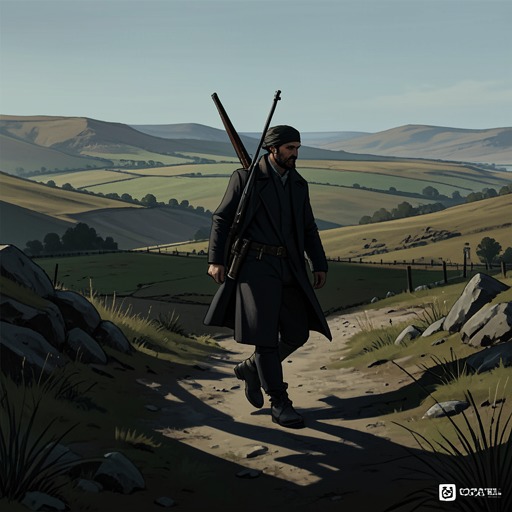
Lawson
The ShepherdLawson is the first-person narrator whose mission to locate a vampire guide develops into a story of loyalty tested by death. The available scenes establish him through sharp contrasts: a wry, bodily self-awareness at the story’s opening; a dangerous assignment involving the Taliban’s cross-border movement; and, at the end, a promise to Veena that he keeps by carrying her body across the border.
Identity and Introduction
Lawson’s introduction is deliberately ordinary in scale. At the opening of Chapter One, his beard itches, and he reflects that he has never liked facial hair on himself but has disliked shaving too. He once considered using electrolysis to destroy the follicles, yet never found the time. The complaint is mundane and faintly comic: before the narrative’s lethal stakes take over, Lawson is presented as someone inhabiting an inconvenient body and observing it with impatience and humor.
That bodily awareness later acquires a different weight. In the final border-crossing scene, his legs ache, his feet feel close to giving out, and sweat stings his eyes. The contrast does not turn the opening joke into a prediction; rather, it makes physical endurance a recurring register through which the narrative presents him. At first the body is an irritation to be shaved or altered. At the end it is the means by which he carries someone he refuses to abandon.
The Mission and Its Stakes
Lawson’s assignment emerges in a conversation with Niles about the difficulty of monitoring Taliban fighters moving between Pakistan and Afghanistan. Niles describes a landscape of trails, valleys, and crevices too extensive for coalition forces to watch in its entirety. When Lawson demands the point, Niles explains that a target has been identified and, after a dramatic pause, says the target is one of their own.
Lawson’s immediate response is to ask whether the target is a vampire and what he is doing in that dangerous world. Niles identifies him as a shepherd. Later, Lawson explains the term by describing the man’s work: he guides Taliban fighters across the border from Pakistan into Afghanistan. The title therefore names a role in the fighters’ movement, not simply a pastoral occupation. Lawson does not know the target’s name; he knows what the man does. That distinction keeps the mission focused on a function with consequences for the border conflict, rather than on a personal history the available scenes do not disclose.
Niles’s briefing also establishes the mission’s moral and practical tension. The target belongs to Lawson’s own kind, yet is entangled with a violent armed network. Lawson asks why that would be sufficient reason to track him in the middle of the night. His answer shifts attention to the target’s payment, suggesting that compensation is central to Lawson’s motive for pursuing him. The excerpt does not specify the payment, so the precise grievance remains unstated; what it does establish is that Lawson’s reason is not merely the target’s identity or occupation.
Veena and the Final Promise
At the close of Veena’s life, Lawson stays physically close to her. When she asks to be taken back home, he holds her, strokes her hair, and promises to bring her there. He remains with her until she dies. The scene makes his relationship to her legible through presence and action rather than through a broader account of their history: he hears what she wants, answers with a commitment, and does not leave her in her final moments.
The promise matters because it continues beyond the moment in which it is spoken. Lawson’s phone goes dead; three hours later, he struggles across the border with his equipment in disarray, an M4 in his right hand, and Veena’s body across his shoulders. He is exhausted, but he has not left her behind. His statement that he would not have done so after what she did for him confirms a debt between them without explaining its particulars. The narrative gives the reader the consequence of that history, not its full account: Lawson repays it by carrying her.
Change, Ending, and Narrative Role
The movement from the opening scene to the ending is a change in what Lawson’s physical discomfort signifies. Early on, his attention to his beard and his indecision about shaving establish a comic, unheroic point of entry. At the end, the details are again physical, but now they measure the cost of an obligation: aching legs, failing feet, disordered gear, sweat in his eyes, and Veena’s weight across his shoulders. The closing action does not erase the exhaustion. It shows Lawson continuing despite it.
Lawson’s narration also controls how much of the story is disclosed. The reader receives the mission through his clipped exchange with Niles, and Veena’s last request through Lawson’s remembered words and gestures. In both cases, events are anchored in what Lawson hears, asks, promises, and does. The target’s identity remains incomplete, and the history behind Veena’s debt is left unexplained in these scenes; meanwhile, the physical outcomes are exact. Lawson knows the shepherd by his work, and Veena’s body is carried over the border by the man who promised to bring her home. His final significance lies in that fulfilled commitment: when return can no longer mean restoring Veena to life, he makes it mean refusing to leave her behind.